Precooked Sea Bass: Healthy, Tasty & Easy to Prepare
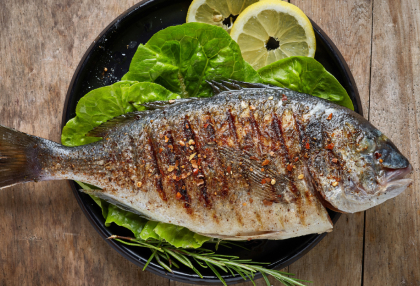
Few fish are as closely tied to the Greek cuisine as sea bass. Grilled whole over charcoal, dressed in nothing more than olive oil, lemon and oregano, it has been the centrepiece of Sunday lunches and seaside tavernas for generations. What has changed is not the fish, but how easily it reaches the plate.
Today, most of the sea bass eaten across Europe comes from Mediterranean aquaculture, and a large share of it is raised in Greek waters. That combination of local farming and modern processing is what allows a fish once reserved for weekend cooking to become a weeknight option.
Why Greek waters produce some of the world’s best sea bass
Greece is the largest producer of farmed sea bass within the European Union and a leading Mediterranean producer. Farming is concentrated in sheltered bays and open-sea cages along the Aegean and Ionian coastline, where stable temperatures, strong currents and clean, deep water create ideal growing conditions for the species.
That geography matters more than it sounds. European sea bass, or branzino, is a slow-growing fish that develops its texture and flavour over time, and Greek conditions let it reach market size in a reasonable window without being pushed. The result is the firm, delicate, flaky flesh that makes the species recognisable, and the reason farmed bass has become one of Greece’s most significant agricultural exports.
What aquaculture actually brings to the table
Aquaculture is often discussed in terms of volume, but for anyone buying fish the real benefits are more practical.
The first is year-round availability. Wild catches depend on season, weather and quota, which means the fish you want is not always the fish you can find. Farmed sea bass is harvested on a planned cycle, so supply stays steady and prices are predictable throughout the year.
The second is traceability. A farmed fish has a documented history: where it was hatched, what it was fed, when it was harvested and where it was processed. That level of detail is almost impossible to reconstruct for wild-caught fish bought at a counter, and it is what allows certifications and food-safety standards to be meaningful..
The third is pressure taken off wild stocks. Every farmed fillet is one that did not have to be caught at sea, which matters in a region where several wild populations are under strain. Responsible farming is not a compromise on quality, it is what keeps a Mediterranean staple on the table without draining the Mediterranean sea itself.
Sea bass and the Mediterranean diet
The Mediterranean diet is consistently ranked among the healthiest in the world, and fish sits close to its centre. Nutritionists generally recommend eating fish at least twice a week, yet most households fall short of that, usually for reasons that have nothing to do with taste.
Sea bass makes this target easier to hit. It is a lean source of high-quality protein, supplying all the essential amino acids the body cannot produce on its own, with far less saturated fat than most red meat. A single fillet delivers a substantial portion of daily protein needs without a heavy calorie load, which is part of why white fish is featured so often in Mediterranean cooking.
It also contains omega-3 fatty acids, the fats associated with cardiovascular and brain health. Sea bass is a leaner fish than salmon, so its omega-3 content is more moderate, but it is a meaningful contributor across a week of balanced eating, and it comes alongside vitamin D, vitamin B12, selenium and iodine, nutrients that are harder to source from land-based proteins.
The Mediterranean approach has never been about one miracle ingredient. It is about frequency: olive oil, vegetables, pulses, whole grains and fish, eaten regularly rather than occasionally. Sea bass fits that pattern naturally, provided it is easy enough to cook that it actually makes it on the menu.
The Greek way with sea bass
Greek cooking treats sea bass with deliberate restraint. The classic preparation is whole fish on the grill, finished with ladolemono, the simple emulsion of olive oil and lemon juice that has dressed Greek fish for centuries. Add oregano, little sea salt, and the fish is left to speak for itself.
The variations are regional and endless: baked plaki-style with tomato, onion and olive oil, wrapped in vine leaves or parchment with herbs, served alongside horta (wild greens), roasted potatoes or a simple village salad. What they share is a conviction that good, tasty fish needs very little done to it.
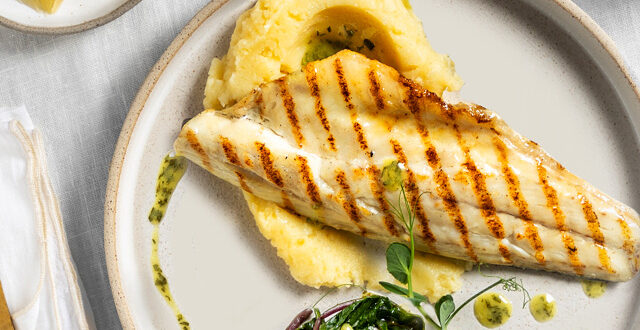
That philosophy translates easily to the modern plate. Recipes such as the grill-marked sea bass with vegetables keeps the traditional pairing intact with none of the fuss. A branzino bowl moves the same fish into a format closer to how people actually eat on a weekday. And bao buns with breaded branzino, sriracha mayonnaise and coleslaw show that a Mediterranean fish is perfectly at home far outside Mediterranean cooking.
Simplifying the process with precooked sea bass
For most people, the barrier to eating more fish was never the fish itself.
Before, putting sea bass on the table meant a trip to the fish counter, then scaling, gutting, trimming fins and checking for bones. It meant a kitchen that smelled of fish for the rest of the evening, a sink and chopping board that needed separate cleaning, and raw fish that had to be cooked within a day or two of buying it. On top of all that sat the genuine risk of overcooking it, because fish is unforgiving and a few minutes decides whether dinner is excellent or dry. For anyone cooking after a full working day, chicken wins that comparison almost every time.
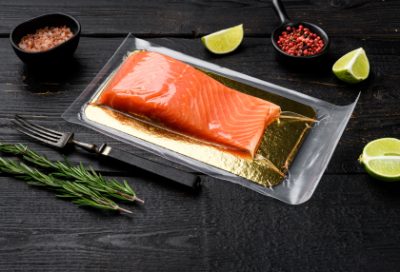
Now, precooked sea bass fillets arrive cleaned, boneless, portioned and already cooked. There is no scaling, no deboning, no raw fish on the counter and no lingering smell. The fillet goes into the oven or pan to warm through, and it comes out the same every time, without losing its original weight, because the required delicate cooking has already been done under controlled conditions.
The practical result is that high-quality protein stops being a difficult project. Sea bass becomes something you can serve on a Tuesday, in the time it takes to roast vegetables alongside it, without the preparation that kept it off the menu in the first place.
A Mediterranean staple, made simple
Sea bass earned its place on Greek tables long before anyone wrote about omega-3s or ranked eating patterns. It stayed there because it tastes good, it suits simple cooking and it comes from waters that have always provided it.
What modern aquaculture and careful processing add is access: the same fish, raised to consistent standards in Greek waters, prepared so that eating well does not depend on having an hour and a fishmonger nearby. For a diet built on eating fish often rather than rarely, that convenience is not a shortcut. This is the entire point.